Running a business today is not just about offering a great product or service. More and more people search online before they make a decision—where to shop, what to buy or who to contact. That’s why digital marketing for businesses matters so much.
No matter if you run a bakery a boutique, a salon, a tuition centre, a home-based business, a restaurant, a consultancy or any kind of service business being present online helps you connect with the audience. It also helps build trust with people who are just getting to know you.
The best part? You don’t need a marketing budget to get started. With the plan even small steady efforts, in digital marketing can make a real difference. Consistency and smart choices go a way.
What Is Digital Marketing for Small Businesses?
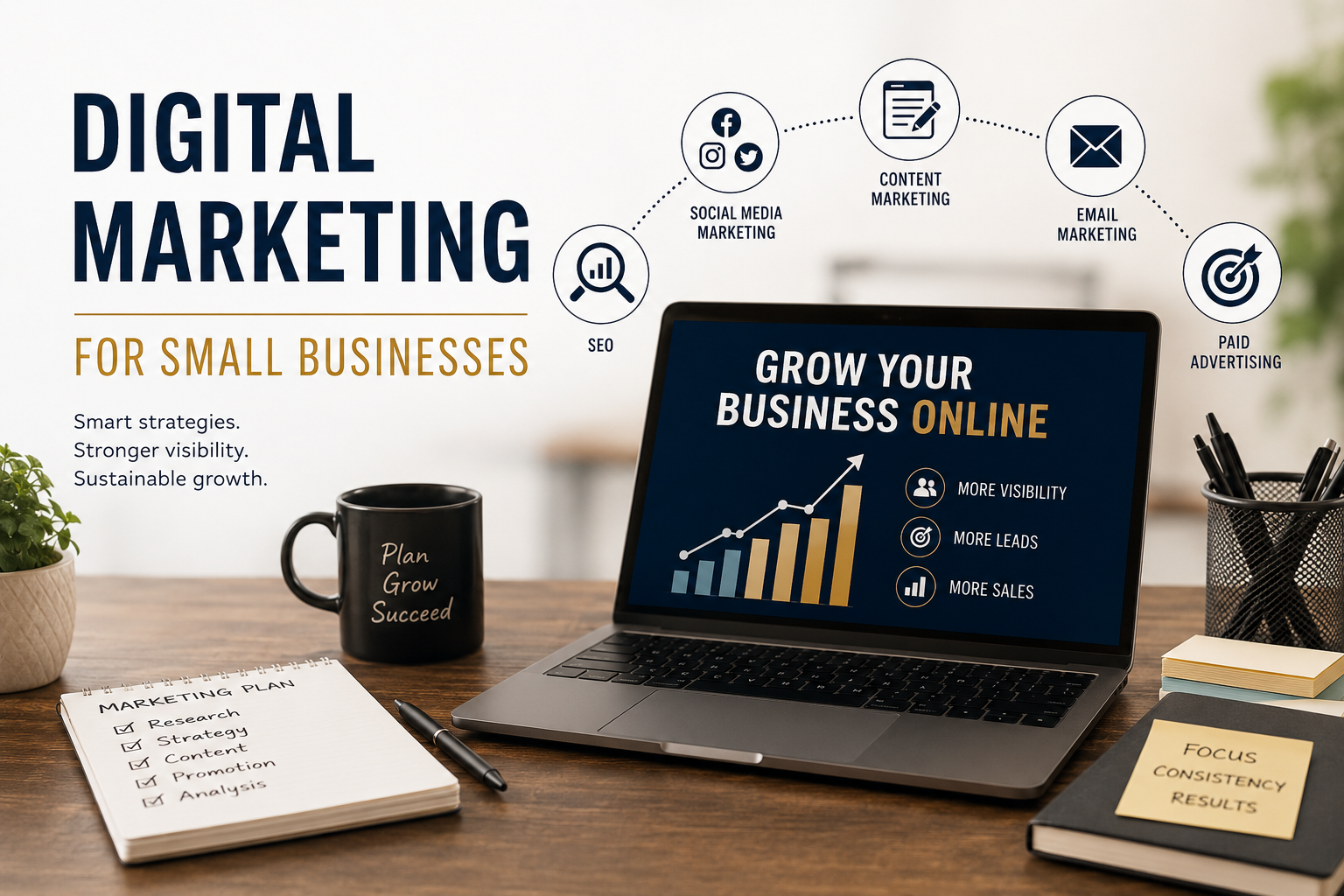
Digital marketing for small businesses means using online platforms and digital strategies to promote a business, connect with customers, generate leads, and increase sales.
It can include:
- Search Engine Optimization (SEO)
- Social media marketing
- Content marketing
- Email marketing
- Website marketing
- Google Business Profile
- Search engine marketing
- Online advertising
The important thing is not to use every digital marketing channel at once. A successful strategy starts by understanding the business, its audience, goals, and budget.
Why Do Small Businesses Need Digital Marketing?
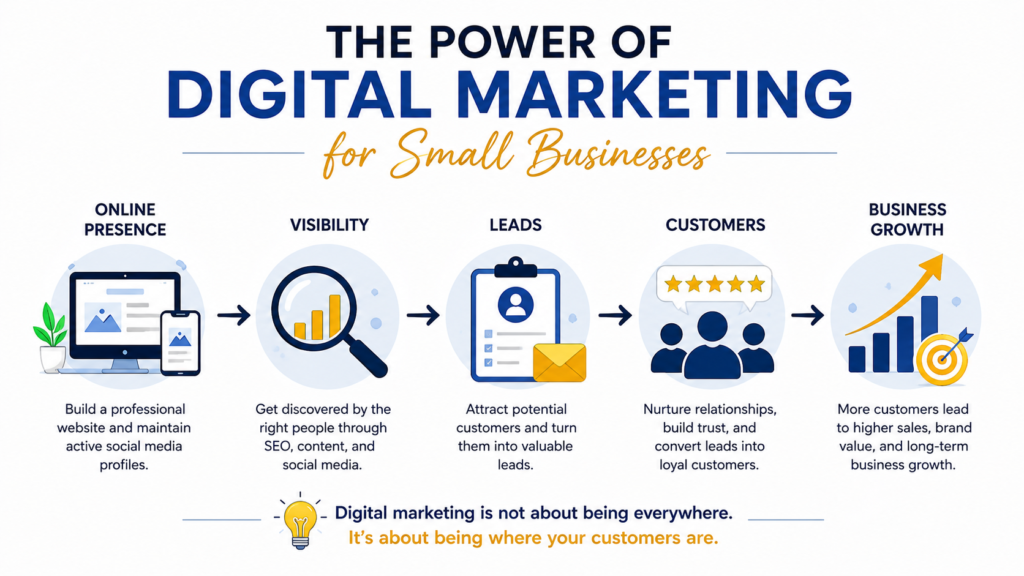
Traditional marketing methods can still work, but customer behaviour has changed. Before visiting a business or making a purchase, many people first search online.
A strong digital presence can help a small business:
- Reach new customers
- Build brand awareness
- Increase online visibility
- Develop customer trust
- Generate enquiries and leads
- Promote products and services
- Compete with larger businesses
This is why digital marketing for small businesses is no longer something that only large companies should consider.
1. Build a Strong Online Presence
The first step in digital marketing for small businesses is creating a professional online presence.
Your website and social media profiles should clearly communicate:
- What your business offers
- Who your services are for
- Where you are located
- How customers can contact you
- Why customers should choose you
Your online presence is often the first impression people have of your business.
A beautiful website alone, however, is not enough. It should also be easy to navigate, mobile-friendly, informative, and designed to guide visitors towards taking action.
2. Use SEO to Get Found on Google
Search Engine Optimization, commonly known as SEO, helps your website appear when people search for relevant products or services.
For example, someone looking for a service in their area may search for terms such as:
- Digital marketer near me
- Bakery in Palakkad
- Best salon in Palakkad
- Home tutor near me
- Graphic designer in Palakkad
A good SEO strategy helps businesses become more visible to people who are already searching for what they offer.
For small businesses, local SEO can be particularly valuable because it focuses on reaching customers in specific locations.
3. Make Use of Google Business Profile
For businesses that serve customers locally, a Google Business Profile can be an important part of digital marketing for small businesses.
A well-maintained profile can help potential customers find useful information such as:
- Business location
- Opening hours
- Phone number
- Website
- Photos
- Customer reviews
- Products or services
Keeping this information accurate and regularly updated can make it easier for potential customers to discover and contact your business.
4. Grow Through Social Media Marketing
Social media gives small businesses an opportunity to communicate directly with their audience.
Platforms such as Instagram and Facebook can be used to:
- Introduce your products
- Share helpful information
- Show behind-the-scenes content
- Answer customer questions
- Share customer experiences
- Build a community around your brand
However, simply posting every day does not automatically create growth.
Good social media marketing starts with understanding your audience and creating content that is useful, interesting, or relevant to them.
Instead of asking, “What should I post today?” try asking:
“What does my audience need to know, solve, or understand?”
That small change in thinking can make your content much more purposeful.
5. Create Content That Helps Your Customers
Content marketing is another important part of digital marketing for small businesses.
Content can include:
- Blog posts
- Instagram posts
- Reels
- Videos
- Guides
- FAQs
- Educational posts
- Case studies
For example, a skincare business could create content explaining how to choose products for different skin types.
A bakery could share tips about choosing a cake for different occasions.
A digital marketing professional could explain simple ways small businesses can improve their online presence.
Useful content helps businesses demonstrate knowledge and build credibility before asking customers to buy.
6. Make Your Website Work for You
Your website should not simply look good. It should have a purpose.
A potential customer who visits your website should quickly understand:
What do you offer?
Who do you help?
Why should they trust you?
What should they do next?
Clear calls to action such as “Get in Touch,” “Request a Quote,” “Book a Consultation,” or “WhatsApp Us” can make it easier for visitors to take the next step.
This is where website design and digital marketing work together.
A website may receive visitors through SEO or social media, but if those visitors cannot easily understand the offer or contact the business, the marketing effort can lose its value.
7. Try Paid Advertising Strategically
Organic marketing can take time. Paid advertising can help businesses reach specific audiences more quickly.
Platforms such as Meta Ads and Google Ads allow businesses to target people based on factors such as location, interests, search behaviour, and demographics.
But paid advertising should not simply mean spending money to get more views.
Before running an advertisement, a business should understand:
- What is the goal?
- Who is the target audience?
- What action should people take?
- How much can the business afford?
- How will the results be measured?
A small, well-planned campaign can be more useful than a large campaign without a clear strategy.
Common Digital Marketing Mistakes Small Businesses Should Avoid
Many businesses start digital marketing for small businesses with enthusiasm but stop when they do not see immediate results.
Here are some common mistakes:
Posting Without a Strategy
Posting randomly makes it difficult to build a consistent brand message.
Trying Every Platform
Being active on five different platforms is not necessary if your customers mainly use one or two.
Ignoring SEO
Social media can bring attention, but search engines can help people actively looking for your products or services discover you.
Focusing Only on Followers
A large follower count does not automatically mean more customers.
Reach, engagement, enquiries, leads, conversions, and sales can be more meaningful indicators depending on your goal.
Expecting Instant Results
Some digital marketing strategies, especially SEO and content marketing, take time to produce results. Consistency and measurement are important.
How Much Should a Small Business Spend on Digital Marketing?
There is no single budget that works for every business.
A local home-based business and an established company with multiple locations will have very different marketing needs.
Instead of asking:
“How much should I spend?”
start with:
“What result am I trying to achieve?”
For example, your first priority might be improving your website, building local visibility, creating better content, generating enquiries, or running a small advertising campaign.
Once the goal is clear, the budget can be planned around it.
A Simple Digital Marketing Strategy for Small Businesses
If you are completely new to digital marketing for small businesses, you do not need to do everything at once.
Start with these steps:
Step 1: Understand Your Audience
Know who your ideal customers are, what they need, and what problems your business solves.
Step 2: Improve Your Online Presence
Make sure your website, Google Business Profile, and social media profiles contain accurate and useful information.
Step 3: Choose the Right Marketing Channels
Focus on the platforms where your potential customers are actually spending time.
Step 4: Create Useful Content
Share content that answers questions, solves problems, demonstrates expertise, and builds trust.
Step 5: Work on SEO
Optimize your website and local online presence so that relevant customers can find you through search.
Step 6: Measure Your Results
Track meaningful numbers such as website visits, enquiries, leads, engagement, conversions, and sales.
Step 7: Improve Over Time
Digital marketing is not a one-time activity. Analyse what works, improve what does not, and continue testing new ideas.
Final Thoughts
Digital marketing for small businesses does not have to be complicated or expensive.
The most effective approach is often a focused strategy built around the right audience, the right message, and the right channels.
You do not need to be everywhere.
You need to be where your customers are.
You do not need to post endlessly.
You need to create content with a purpose.
And you do not need to spend a huge amount of money.
You need to understand what you are trying to achieve and measure whether your marketing is helping you get there.
For a small business, digital marketing is not simply about getting more likes or followers. It is about becoming easier to find, easier to trust, and easier to choose.
Frequently Asked Questions
What is digital marketing for small businesses?
Digital marketing for small businesses is the use of online channels such as SEO, social media, websites, content, email, and online advertising to reach customers and grow a business.
Is digital marketing expensive for a small business?
Not necessarily. Small businesses can begin with affordable strategies such as local SEO, content marketing, social media, and Google Business Profile optimization before investing heavily in paid advertising.
Which digital marketing strategy is best for a small business?
There is no single strategy that is best for every business. The right approach depends on the target audience, business goals, location, industry, competition, and budget.
Does SEO help small businesses?
Yes. SEO can help small businesses become more visible when potential customers search for relevant products or services online. Local SEO can be especially useful for businesses serving a particular area.
How long does digital marketing take to show results?
It depends on the strategy. Paid advertising can generate results relatively quickly, while SEO and content marketing generally require more time and consistent effort.
Ready to Grow Your Business Online?
A strong digital presence starts with the right strategy.
If you are looking for practical digital marketing for small businesses, the first step is understanding where your business currently stands and what can be improved.
Let’s build a digital marketing strategy that focuses not just on visibility, but on meaningful business results.